Toyokawa City
Toyokawa
is in the southeast of Aichi Prefecture and has a good natural
environment. The city was created as a municipality in Showa 18
(1943). And It used to be called "HIno kuni" (province
of ear). The city has history and tradition.
Toyokawainari
Toyokawainari
is one of the three big Inaris in Japan. It is said that about one million
and two hundred thousand people visit here on the first three
days of the new year. Toyokawainari is a temple of the Soutou
Sect. It started in 1441. And many historical heroes believed
in it as a God which gave happiness. In the Edo era, people who
wished for prosperity in business and better luck believed in
it, too.
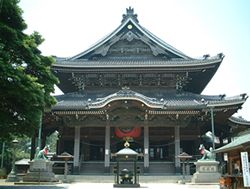
This is the "Hon den",the main temple. It was built between Meiji 27 and 30
This is
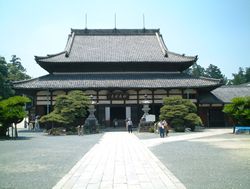
the "Hattou", the big main temple. It was built between
Meiji 27 and Showa 5.
Festivals in Toyokawa
Various festivals are celebrated in Toyokawa through the seasons.
Åôthe "Unagouji"
festival
It is known
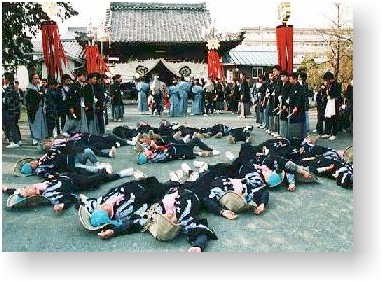
as one of the most outrageous festivals. Unagouji means a maggot. The figures which
lie down on the road at the tail of the festival procession look
like maggots. So it is called Unagouji.
Åôthe "Tezuthu Enka"
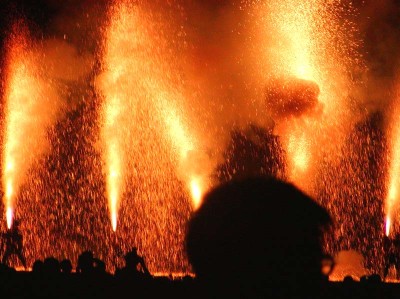
(handheld fireworks)
It has continued
from the Edo era and is celebrated in many places in the city.
Åôtwo city festivals
Åõthe "Oiden" festival in spring
Å@ It was performed
as a commercial festival, an agricultural festival, and a tree
planting festival at first. The parade called 'princess highway
dream romance' is performed. It reproduces a trip by a princess
in the Edo era. It is the main event of spring which has 100,000
or more people every year.
Åõthe "Tezuthu" festival in
summer
Å@Å@This festival
started in commemoration of the 45th anniversary of municipal
organization in Showa 63. The climax is the contest of Tezutsu
Enka (handheld fireworks). Hundreds of them are launched over
2 hours
Cultural Assets
In the Nara
era, Toyokawa was the center of the Mikawa Province. The city
was a "kokufu" (provincial capital), and had a "kokubun
ji" (provincial temple) and "kokubun niji" (provincial
convent).
In later years,
many histrical figures (for example, Yoritomo Minamoto, Yoshisada
Nitta, Yoshimoto Imagawa, Ieyasu Tokugawa, Yukichi Fukuzawa) lived
in or visited the city. Toyokawa has one of the largest and most
valuable cultual assets in Japan.
1: 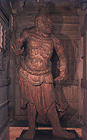 2:
2:
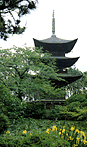 3:
3: 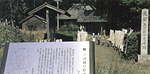
1 Niouzou in Zaiga temple
It was made
in the Heian era. It was specified to be a cultural property of
Japan in Showa 55. Now it is exhibited in Nara National Museum
2 Sanmyou temple
The Three-storied
Tower was built in 1531. The first layer and the second layer
are in Japanese style and the third layer is in Chinese style.
It was specified to be a cultural property of Japan in Meiji 40.
3 The remains of the
Kokubun niji
The Kokubun
ji and The Kokubu niji were built by Emperor Shomu's imperial
edict in Tenshou 13 (in 741). The Kokubu niji has a vast areaÅiabout
180m aroundÅjand it is one of the greatest in scale in Japan.
click here
Å® toyokawa and inazawa
click here Å® inazawa