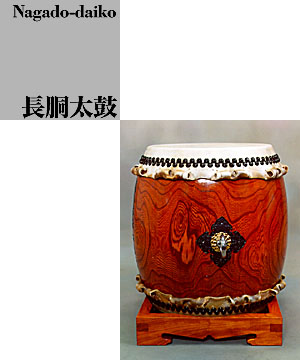
The body of these drums is carved in a beer barrel shape from
a single giant log of a hard wood like cypress (hinoki), zelkova
(keyaki), oak (kashi), camphorwood (kusunoki), or chestnut (kun).
To both ends are affixed heavy horse or cowhide skins with two
rows of heavy duty tacks. Cowhide is now the most commonly used.
zelkova is the most highly prized for the dynamic beauty of its
grain. It is quite common for a yin-yang mark (tomoe) or triple
comma mark (mitsudomoe) to be drawn on the heads. The usual size
have a body 50-100 cms long and a diameter of 4090 cms.
There is a drum called the shinko on the Korean Peninsula with
a length of 165 cm and diameter of 120 cm. It is thought that
this may be the ancestor of the Japanese nagado-daiko. The Korean
drum in turn was based on a drum introduced from China in the
12th century so the nagado came from China to Japan by way of
Korea. It spread throughout Japan in the Edo period (1603-1868).
These drums were often perched atop temporary towers built
of bamboo scaffolding (yagura) set in front of theatres in the
Edo period where they would announce the beginning and ending
of performances, for this reason they also came to be known as
yagura-daiko. This tradition persists today in the world of Sumo
wrestling. They were also played from within castle walls to announce
the time so sometimes were referred to as 'time drums' (toki no
taiko). Later they were used as festival drums for shrine celebrations,
included in the Kabuki orchestra for sound effects and often accompanied
Bon-odori dances. Nowadays it is commonly used as the principal
instrument of stage performing taiko groups throughout Japan and
the world.
The traditional way of playing the nagado-daiko was to simply
set it on the floor to play it, or to set it sideways on a raised
stand and play it that way. During festivals it was common to
see it lain sideways on a festival cart or 'float' drawn through
the streets by either celebrants or oxen with the drummer riding
the cart, or walking along side spurring on the parade with his
playing. Attached to both sides of the nagado-daiko are two stout
metal rings which are left over from the days when it needed to
be firmly lashed to the moving cart. Nowadays the drums are mounted
in an enormous variety of ways in keeping with the needs of different
performance styles.
back